Original Outdoors

Gear Review

Soto Amicus Stove (Without Igniter)

7th November 2023

The Soto Amicus stove, (without the piezo igniter), is a lightweight, compact option that promises wind resistance and ease of use for outdoor enthusiasts.

It’s not packed with features, but it ticks the most important boxes: reliable performance in poor conditions and minimal weight in your pack.

Having used it extensively, I’ve come to appreciate both its strengths and its small, but noticeable, weaknesses.

Standalone lightweight canister-top stoves fell out of favour as cooking systems and remote canister stoves became cheaper, lighter and more accessible. My trusty MSR Pocket Rocket got pushed to the back of the gear cupboard, and I turned away from canister-top stoves as being anything more than a useful backup.

Will this small, Japanese windproof stove bring me back? Even without an igniter?

Design and Specifications

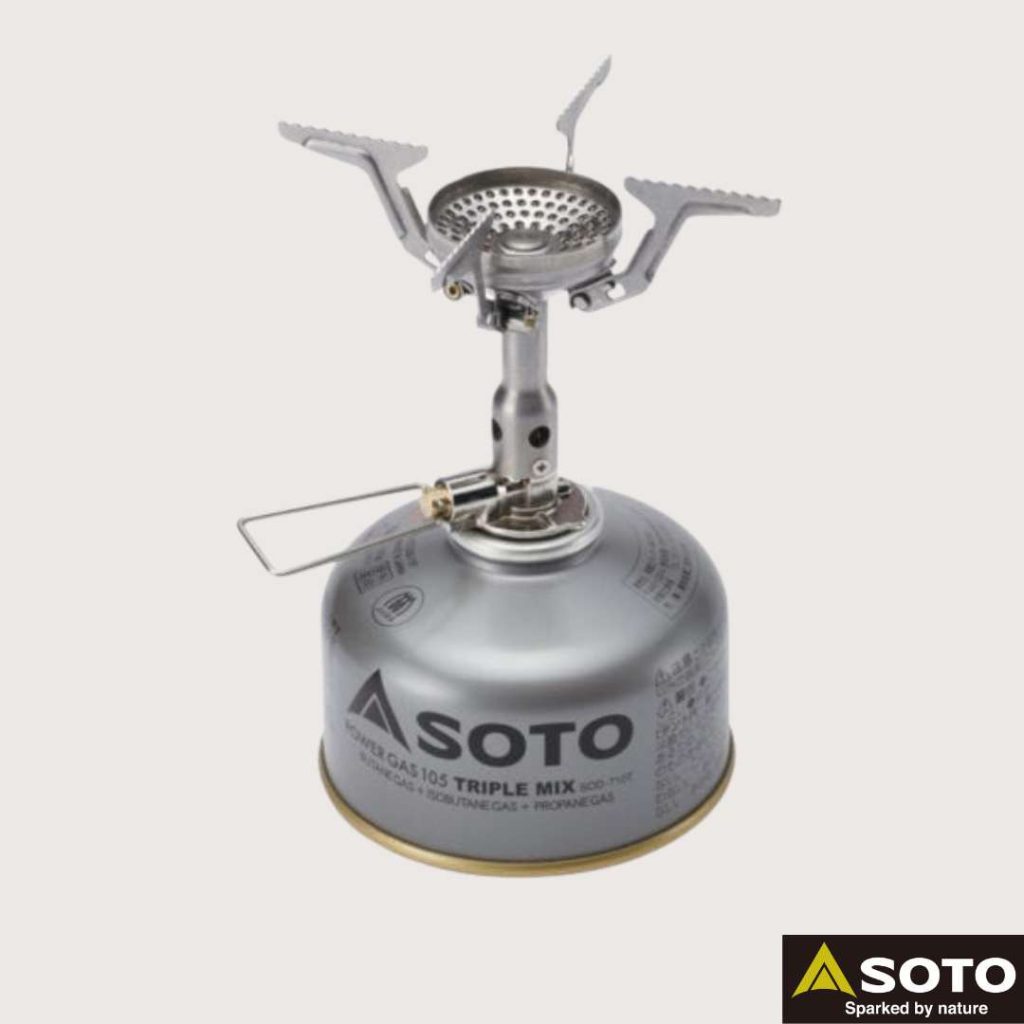
The Soto Amicus stove weighs in at just 75g, making it a great option for backpackers and ultralight hikers who want to cut weight without sacrificing reliability. Made of stainless steel, it’s sturdy enough to handle regular use, and its compact design allows it to fold down neatly, taking up very little room in your kit.

The stove has four foldable arms that support your cookware, and when fully deployed, the pot supports are stable enough for most small-to-medium pots. However, the folding mechanism can be a bit fiddly. The arms are secured by a spring-retention hinge, which feels a little delicate, especially when setting up or breaking down the stove in cold or wet conditions. Over time, I suspect this could be a potential failure point if not handled with care.

The stove features a concave burner head, which is key to its wind-resistant performance.

Unlike some other designs where the flame is easily disrupted by the wind, the Amicus keeps its flame steady, even in blustery conditions. In practice, I found this to be one of the stove’s standout features. On exposed ridgelines and gusty mornings, the flame stayed strong without the need for a windscreen—something that can’t always be said for similar stoves in this price and weight range.

Burner Performance and Wind Resistance

One of the biggest selling points of the Soto Amicus is its ability to maintain performance in the wind. Thanks to the concave burner head and small, recessed jets, the flame is well protected from gusts. This is where the Amicus really excels compared to competitors like the MSR Pocket Rocket 2. Where the Pocket Rocket might start to struggle without additional protection, the Amicus keeps on burning efficiently, which is essential when cooking in more exposed environments.

With a power output of 2,600 kcal/h (3.0 kW / 10,200 BTU), the Amicus boils 500ml of water in just over four minutes under ideal conditions. However, as anyone who has ever tried using a stove outdoors will tell you – conditions are rarely ideal, and this is where the Amicus’s wind performance comes into its own.

Even in moderate wind, it boils water efficiently without the need to shelter it, unlike the Pocket Rocket 2 or my Alpkit Kraku, which both benefit from a windscreen in similar conditions.

Ease of Use

The Amicus seems to be designed with simplicity in mind. There’s no built-in igniter on this model. This might be a downside for some, but for me it’s not an issue for me.
Built-in igniters can fail (and eventually will), and I prefer to carry a separate lighter or firesteel anyway. It’s just one less thing to go wrong.

The folding arms, though functional, do present a bit of a challenge. They can be tricky to deploy, especially with cold fingers or when you’re in a rush to get a brew going. While they offer decent support for most cookware, the spring-retention mechanism does feel like it could wear out over time. It’s not a deal-breaker, but it’s something to keep an eye on if you’re planning to use the stove heavily over a long period.

One other thing to note is that the stove doesn’t have much in the way of simmer control. It’s more of an “on or off” setup, so you’ll need to keep an eye on your cooking to avoid burning your food. 

Comparisons

It seems natural that the Soto Amicus often will be compared to MSR’s Pocket Rocket 2.

In terms of power and boil times, the Pocket Rocket 2 might have a slight edge in perfect conditions. It’s a bit more powerful at 2,800 kcal/h (3.3 kW / 11,000 BTU) and can bring water to a boil a bit quicker. But the Pocket Rocket 2 falters in the wind, where the Amicus really shines. If you’re regularly cooking in windy conditions, the Amicus is the better bet without needing to carry a separate windscreen.

The BRS-3000T is another popular ultralight competitor, and while it’s lighter at just 25g, it’s much more vulnerable to wind and generally less durable than the Amicus. The BRS might save you some weight, but you’ll be sacrificing performance and reliability.

Durability and Potential Weaknesses

For the most part, the Amicus feels well-built. It’s made of stainless steel, which should stand up to regular use and the occasional knock. However, as mentioned, the folding pot supports feel a bit fragile. The spring-retention hinge that holds them in place is a point of concern. Over time, especially with regular folding and unfolding, this could wear out. It’s not something I’ve personally experienced yet, but it’s worth being mindful of, particularly if you’re relying on this stove for extended trips.

Pros and Cons

Pros:

  • Excellent wind resistance: The concave burner head design performs exceptionally well in windy conditions without the need for a windscreen.
  • Lightweight and compact: At just 75g, it’s easy to pack and carry, making it ideal for ultralight backpackers and campers.
  • Reliable and simple: No built-in igniter means one less component to fail, and the overall design is straightforward and user-friendly.

Cons:

  • Fiddly pot supports: The folding arms can be tricky to deploy, especially with cold hands, and the spring-retention hinge feels like a potential weak spot.
  • Limited simmer control: The stove doesn’t offer fine control over flame intensity, making it less ideal for more delicate cooking tasks.
  • No built-in igniter: Some users may prefer the convenience of an integrated ignition system, though this can be mitigated by carrying a lighter or firesteel.

Final Thoughts

The Soto Amicus (without igniter) is an excellent choice for anyone looking for a lightweight, wind-resistant stove. Its standout feature is undoubtedly its ability to perform in windy conditions without needing a separate windscreen, something that gives it a clear advantage over stoves like the MSR Pocket Rocket 2.

That said – it’s not perfect. The fiddly pot supports and potential wear on the spring-retention hinge are minor drawbacks, but they’re worth considering if you plan to use the stove regularly or in tough conditions. For those who don’t mind carrying a separate ignition source and are looking for a stove that can handle windy environments with ease, the Amicus is a solid, reliable option.

In short, the Soto Amicus does what it says on the tin: it’s light, efficient, and holds up well in poor weather. If you need a no-nonsense stove that won’t let you down when the wind picks up, it’s definitely worth a spot in your pack.

Soto Amicus Stove (Without Igniter)

Available via Amazon – affiliate links below.

Pros

Excellent wind resistance: The concave burner head design performs exceptionally well in windy conditions without the need for a windscreen.

Lightweight and compact: At just 75g, it’s easy to pack and carry, making it ideal for ultralight backpackers and campers.

Reliable and simple: No built-in igniter means one less component to fail, and the overall design is straightforward and user-friendly.

Cons

Fiddly pot supports: The folding arms can be tricky to deploy, especially with cold hands, and the spring-retention hinge feels like a potential weak spot.

Limited simmer control: The stove doesn’t offer fine control over flame intensity, making it less ideal for more delicate cooking tasks.

No built-in igniter: Some users may prefer the convenience of an integrated ignition system, though this can be mitigated by carrying a lighter or firesteel.

Review Overview
FUNCTION
DURABILITY
RUGGEDNESS
USABILITY
PRICE
SUMMARY

The Soto Amicus stove (without igniter) is a lightweight, wind-resistant option offering reliable performance for outdoor enthusiasts, though its fiddly pot supports and limited simmer control may require some patience.

4.1

A Mountain Leader with over a decade of experience across the UK and overseas, Richard is our Lead Instructor and a partner in Original Outdoors. He is a specialist in temperate wilderness skills and the wild foods of the British Isles, and also works as a consultant for various brands and organisations. Richard lives in North Wales.

A Life more Wild.

A Life More Wild is the philosophy which underpins everything we do.

It encompasses practical skills, personal development, community learning and a journey to live more intentionally.